
2026 Solar Eclipse in Segovia: Experiencing It from a Hot Air Balloon
|
21 Aug 2026
August 12: All Eyes on the Sky
You start a Wednesday like any other: you have your morning coffee or tea, head off to work, go for a workout, and carry on with your usual routine. But there is something special about that day. It feels different. There is a certain sense of anticipation in the air.
And no wonder.
That Wednesday, August 12, will mark a historic event for Spaniards, residents, and all those visitors travelling to our country to witness it: the 2026 total solar eclipse.
It is a phenomenon Spain has been waiting decades to experience. The last total eclipse visible from Spanish territory took place on October 2, 1959, in Gran Canaria and, if we are talking about mainland Spain, we have to go even further back: to August 30, 1905, when the path of totality crossed Burgos and other surrounding areas.
But if anyone was especially excited for the arrival of that day, it was the Boreal family.
Javier Tarno and Fermín Peluffo, balloon pilots, were not going to settle for watching the sky from the ground. They were going to experience it, quite literally, from above.
“Feet, what do I need you for when I have a balloon to fly?”
— inspired by Frida Kahlo
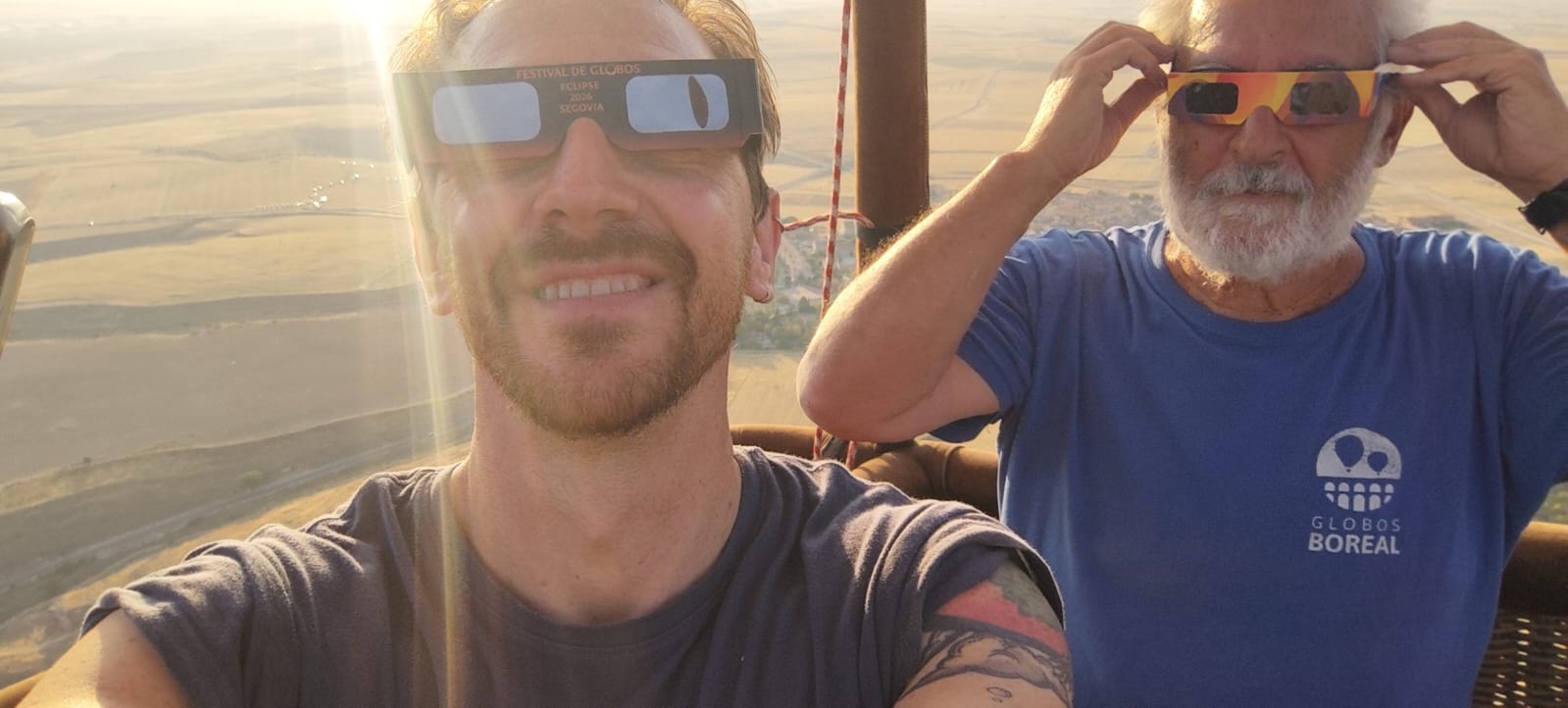
From the 2019 Solar Eclipse in Argentina to the 2026 Eclipse in Segovia
And this is where the story gets even more interesting.
Fermín, who comes from Argentina, already knows what it is like to experience an eclipse surrounded by hot air balloons. In 2019, he was there for the total solar eclipse that darkened parts of the Pacific Ocean, Chile, and Argentina as the sun was setting.
He often tells us the story of how he was part of the chase crew — what we call the ground crew in the ballooning world — during the Argentina Eclipse Balloon Experience.
The event reached its highlight in Villa de Merlo, San Luis, where 25 balloons from different parts of the world came together to experience that very special moment.
On that occasion, Fermín watched the eclipse with his feet firmly on the ground.
This time, seven years later, the story was going to be different.
“Seeing it from the sky this time was a dream come true. In a way, it felt like a second chance after what I experienced seven years ago,” Fermín tells us.
When Day Turned into Night
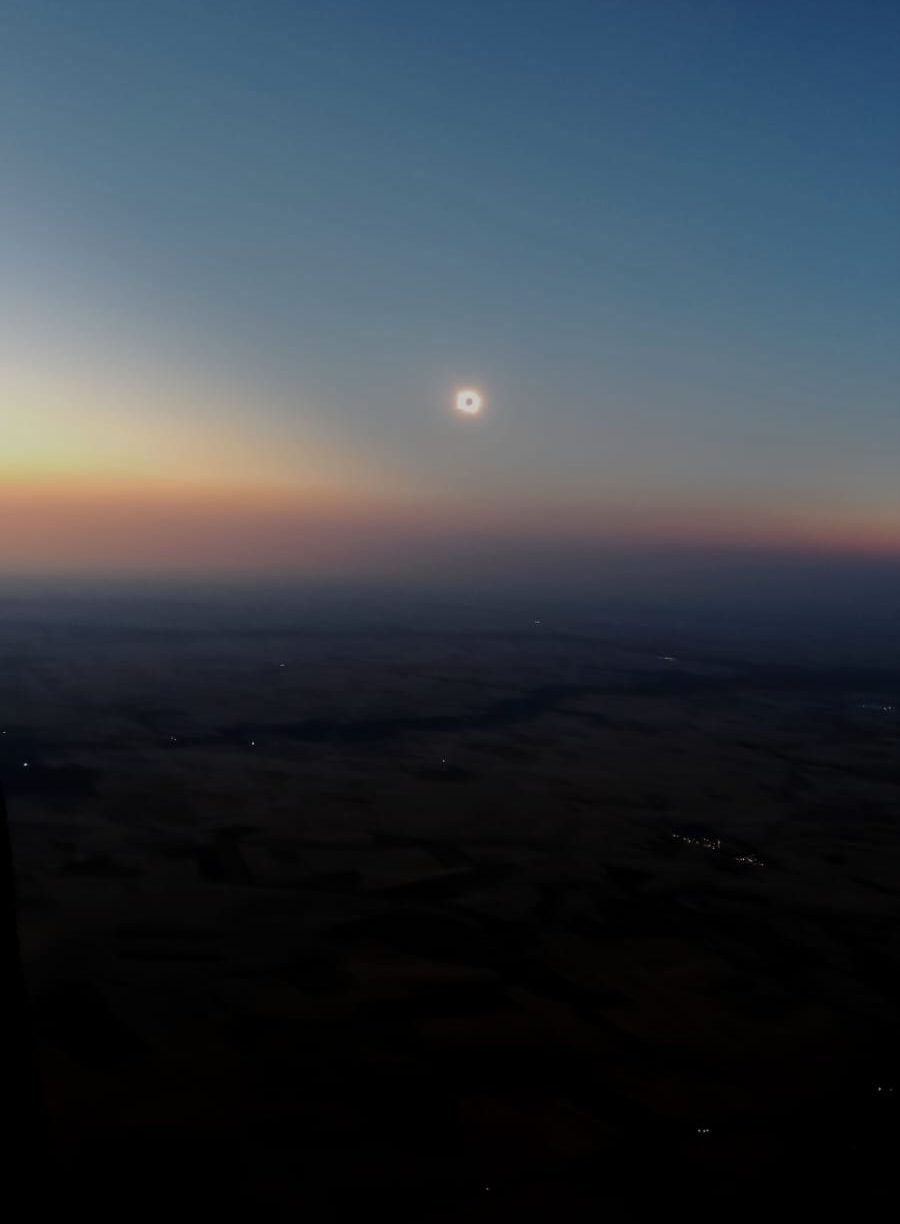
Photo taken from the hot air balloon. 2026 Solar Eclipse.
As the afternoon arrives, preparations begin. And there was Javier Tarno, the boss — although by now we could almost call him the patriarch of the Boreal family. Now retired and 70 years old, but make no mistake: after a lifetime spent around balloons, there is no keeping him out of one, and he certainly wasn’t going to miss a moment like this.
At around 7:00 p.m., we arrived at our usual launch site in Segovia. Some spectators had already gathered there to witness the eclipse, while many others were finding their own spot around the city: the City Walls, the Cathedral, the Alcázar and countless other corners of Segovia became impromptu viewpoints towards the sky.
At around 8:00 p.m., we took off alongside another balloon. Little by little, we climbed until we reached 1,200 metres, as the light began to change and the moment we had all been waiting for drew closer.
And then it happened.
During totality, the temperature dropped slightly, a gentle breeze could be felt and, for a few moments, everything seemed to stand still. Silence fell.
While thousands of eyes across Segovia were turned towards the sky, Javier and Fermín watched from the basket of a hot air balloon as day turned into night and the Moon’s shadow swept across the landscape.
And, by the way, while all of this was happening in Segovia, a few kilometres further north, another member of the family was up in the air.
As a curious side note, Daniel Tarno also witnessed the phenomenon from a balloon over León, where he had been hired to fly that day by the Catalan ballooning company Kontiki. After all, in a family of balloon pilots, perhaps the unusual thing would have been to find both of them on the ground.
“It was a great privilege to experience it, not only from the air, but also to share it with everyone watching from the ground. After all, it is a universal phenomenon, something that transcends us all. For a few moments, it felt like a pause the universe had given us from the constant rush of everyday life,” the team tells us.
Once Is Not Enough: Upcoming Solar Eclipses in Spain
They say that when you give people the chance to experience something extraordinary, they inevitably want more.
And moments like this seem to have exactly that effect.
That day had barely come to an end when we were already coming across articles, calendars and questions about when the next solar eclipse in Spain will take place.
And the interesting thing is, we won’t have to wait too long.
After the total eclipse on August 12, 2026, Spain will once again become a privileged location for astronomical observation with the solar eclipse on August 2, 2027, which will also be total and will be especially visible from the south of the country. And one year later, on January 26, 2028, another eclipse will be visible from Spain — this time, an annular eclipse.
It seems the sky still has a few more dates in store for us.
In the meantime, we are left with the memories, the stories and, fortunately, the images from that day. Some were taken from our basket, while others were sent to us by people who experienced it from the ground.
And among them is one of those photographs that looks as though it had been carefully planned, but could only happen once: the silhouette of a hot air balloon crossing in front of the eclipse.
And although we came back down to earth that day, part of that moment stayed up there. Because some flights end when you land, while others, somehow, stay with you.
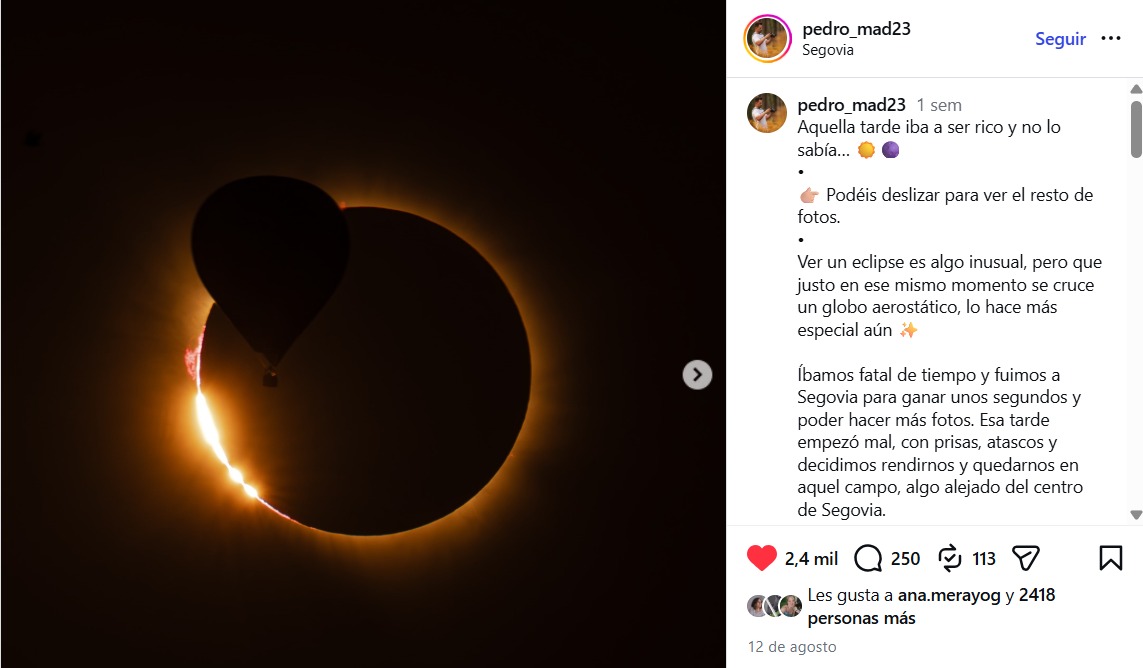
Photograph by pedro_mad23: ver aquí